What CoreWeave’s $1.3 Billion deferred revenue reclassification might be telling us
We attempted to trace a $1.3 billion reclassification from deferred revenue to customer liabilities to see what it might tell us about customer contracts and project delivery.
This is collaborative effort, co-authored with The Dig the newsletter from Francine McKenna. If you value our work, please subscribe!
Deep Quarry is a reader-supported publication. To receive new posts and support my work, consider becoming a free or paid subscriber.
CoreWeave had a strong 2026 second quarter, but that does not mitigate some of the risks Francine McKenna and I have written about before.
We previously looked at CoreWeave’s growing debt load, as well as the company’s heavy dependence on a small number of customers, and the SEC comments on this concentration during CoreWeave’s IPO review. Large commitments from OpenAI and Meta have diversified CoreWeave’s customer base beyond Microsoft, but the underlying concentration risk remains — particularly when billions of dollars of expected revenue depend on a handful of long-term customer contracts with pre-specified performance conditions.
CoreWeave reported revenue more than doubled from a year earlier to a record $2.58 billion, slightly ahead of Wall Street estimates. Revenue backlog reached $104.2 billion, and the company said it had secured more than $25 billion of additional customer commitments in the first weeks of the third quarter. CoreWeave also raised its full-year revenue and adjusted operating income outlook, while increasing its planned 2026 capital spending to $35–$39 billion, according to Reuters.
Investors welcomed the results despite CoreWeave’s continued losses and heavy spending. The shares jumped 19% the following day, with the Wall Street Journal attributing the rally to strong demand for AI computing capacity and record revenue.
The quarter appeared strong. But, we usually tend to go beyond headlines to the financial statements and footnotes because they contain clues about how CoreWeave’s large customer contracts are performing.
A note from Cape Fear Advisors prompted us to dig deeper into how Core Weave recognizes revenue and its performance under specific customer contracts.
In their August 12, 2026, note, Cape Fear Advisors pointed to an unusual $1.3 billion reclassification by CoreWeave. In Q1, the company moved roughly $1.3 billion from deferred revenue, a liability account, to a newly disclosed “customer liabilities” account. However, by Q2, the “customer liabilities” account, had disappeared, and was no longer reported in the footnotes. According to the analysis from Cape Fear Advisors, while the Q1 reclassification was explained, the Q2 reversal was not.
Using their words, “The caption was born on March 31 and was gone by June 30.”
So, what exactly happened to the $1.3 billion liability — and why did a liability large enough to warrant separate disclosure in Q1 disappear from the footnotes just three months later? Is reclassification between deferred revenue and customer liabilities just a label change — or is there more to it?
Let’s look at the accounting guidance first. Deloitte explains similar transactions in its US DART guide. According to Deloitte’s guide and the GAAP revenue recognition standard ASC 606, deferred revenue is classified as a contract liability. The company has received payment or consideration, but still owes the customer performance under the contract, that is, the related goods or services:
A contract liability would exist when an entity has received consideration but has not transferred the related goods or services to the customer. This is commonly referred to as deferred revenue. An entity may also have an unconditional right to consideration (i.e., a receivable) before it transfers goods or services to a customer.
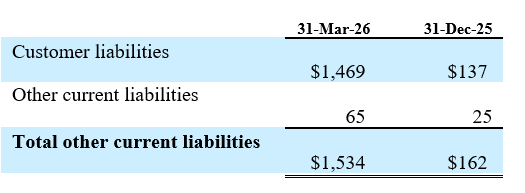
In contrast to deferred revenue, customer liabilities are not defined in GAAP and could reflect a broader category of liabilities associated with a contract with a customer. The term customer liabilities appears in CoreWeave’s Q1 2026 10Q twice — as a footnote explaining the reclassification and within a separate schedule, Other Current Liabilities, as a customer liabilitywithin other current, distinguishing the amount from deferred revenue.
From the 10-Q for the period ended March 31, 2026:
Deferred revenue, including current and non-current balances as of March 31, 2026 and December 31, 2025 was $7.5 billion and $8.2 billion, respectively. The change in deferred revenue in the three months ended March 31, 2026 was primarily driven by reclassification of $1.3 billion to customer liabilities, revenue recognized from deferred revenue at the beginning of the period of $304 million, partially offset by invoicing in advance of performance under contracts.
And also:
Other Current Liabilities
Other current liabilities consisted of the following (in millions):
Source: CoreWeave’s 10-Q for the period ended March 31, 2026.
ASC 606 provides several circumstances in which consideration received from a customer no longer qualifies to be treated as deferred revenue and may be recorded as a separate liability rather than as a contract liability, or deferred revenue. For example, Deloitte explains that when a customer prepayment relates to a period that is cancelable without penalty, the amount should be presented separately from the contract liability or deferred revenue as a refund or similar liability. In that situation, the prepayment is not part of the transaction price associated with remaining performance obligations. If the termination right later lapses, Deloitte notes that the amount may be reclassified to the contract liability and “recharacterized as deferred revenue.”
CoreWeave did not disclose the contractual circumstances behind the reclassification.
So, let us repeat the question: What changed during Q1 2026 to cause the reclassification — and what subsequently changed to make the customer liabilities schedule disappear in Q2?
Deep Quarry is a reader-supported publication. To receive new posts and support my work, consider becoming a free or paid subscriber.
Continue reading this post for free, courtesy of Olga Usvyatsky.